
Generative AI: What It Is and How It Works
An introduction to generative AI, explaining what it is, how it works, and its applications in various fields.
Series: AI Series
- Generative AI: What It Is and How It Works
As artificial intelligence (AI) keeps growing, generative AI has become a massive deal for modern businesses. Its power to make new content, handle boring tasks, and help people make decisions has opened up totally new doors across different industries. In this article, we will look at what generative AI is, how it actually works, and where people are using it.
What is Generative AI (GenAI)?
As we see in the image below, Generative AI is a subset of artificial intelligence that focuses on creating new content rather than simply analyzing or interpreting existing data. It is capable of generating new content, such as text, images, audio, and video, or code that did not exist before, based on the data it has been trained on.
When we say it is "based on data it has been trained on", it means that during the training (learning) phase, the AI studies a massive dataset to figure out the underlying patterns, structures, and relationships within that information. Once it understands those patterns, it can generate new content that looks or sounds like the training data, without directly copying any specific example.
How Generative AI Creates Content
Think of a Generative AI model like a professional chef who has spent years studying Italian cuisine. The chef learns the recipes, core techniques, and flavor combinations. When asked to create a new dish, the chef doesn't just copy a cookbook line-by-line, he uses his knowledge to invent a unique meal that still tastes authentically Italian. Similarly, a Generative AI model learns the "recipe patterns" from its training data and uses them to cook up something original.
However, this kitchen metaphor also reveals the ultimate boundary of AI. If you ask that world-class Italian chef to suddenly compose a classical symphony, he won't be able to do it. Their entire life has been focused on food and flavors, not musical notes and rhythms.
The same rule applies to ai models: a generative model can only create within the domain it has been trained on. If it has been trained on text data, it can generate text; if trained on images, it can generate images, and so on.
Examples of Generative AI Include:
- Text Generation: Writing human-like text, e.g., OpenAI's GPT models and Google's Gemini.
- Image Generation: Creating realistic images or mixing wild concepts from textual descriptions, e.g., DALL-E, Midjourney, Stable Diffusion, and Google's native Nano Banana model series.
- Audio Generation: Producing music, speech, or sound effects, e.g., Suno and ElevenLabs.
- Video Generation: Generating video content, e.g., Runway and Luma's Dream Machine.
- Code Generation: Writing code snippets or entire programs, e.g., GitHub Copilot.
The Technical Building Blocks under the Hood
To understand how an AI gets smart enough to create things, we have to look at the different layers of technology that make it tick. Think of it like a nesting doll—each layer sits inside a larger one, and they all work together to power the final Generative AI engine.
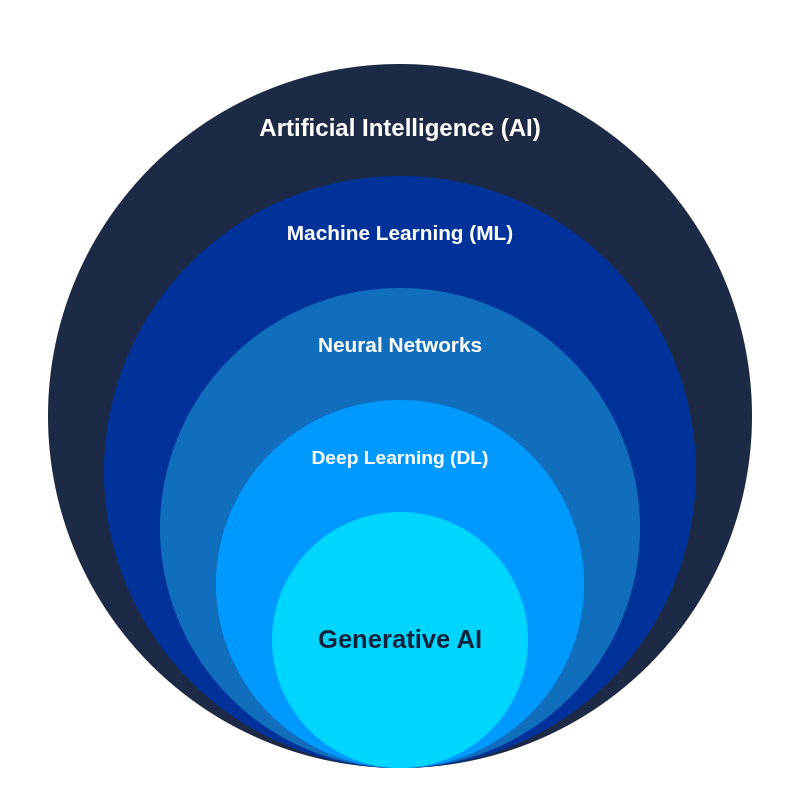 |
|---|
| Layers of AI diagram. Source |
1. Artificial Intelligence (AI)
What It Is: The outermost category. This discipline focuses on mimicking human behavior. Machines learn and perform tasks on their own without explicit instructions on final outputs. Traditional systems analyze data and make decisions, but they do not create new content from scratch.
Chef Example: The Master Chef running the entire restaurant. He oversees the kitchen, manages staff, handles customer service, and controls daily dining operations.
2. Machine Learning (ML)
What It Is: This layer sits inside artificial intelligence. Systems learn directly from data instead of relying on manual instructions. Models process raw data and apply mathematical formulas to find patterns. This allows them to make predictions, such as estimating daily store revenue.
Chef Example: The chef learns which flavor combinations work best over time. He tracks customer reactions, observing clean plates and returned meals. He refines his understanding of taste without relying on a recipe book.
3. Neural Networks (NN)
What It Is: This layer sits inside machine learning and serves as the structural foundation for deep learning. Inspired by the human brain, it uses connected nodes acting like digital neurons. These nodes process incoming data by adjusting internal mathematical parameters, including weights and biases, to increase prediction accuracy. Neural networks handle complex data for image recognition, natural language processing, and speech recognition.
Chef Example: The chef's mental map of flavors, textures, and cooking techniques. His brain connects temperature, acidity, cooking time, and ingredients to build a balanced dish. This mental network helps him make fast decisions in the kitchen.
4. Deep Learning (DL)
What It Is: An advanced layer of machine learning built on multi-layered neural networks. Stacking processing layers allows systems to process unstructured data, including images, raw audio, pixels, or large text libraries. Models learn complex patterns to excel at image classification, speech recognition, and natural language understanding.
Chef Example: The chef's ability to create a multi-course tasting menu. He combines knowledge of flavors, textures, and techniques to design a complete dining experience. Deep learning models analyze complex data to generate structured, contextually relevant content in a similar way.
5. Generative AI (GenAI)
What It Is: The innermost layer. Built on deep learning and powered by neural networks, generative AI moves beyond analyzing or predicting data. It uses learned rules and patterns to construct entirely new content from scratch.
Chef Example: The chef creating a completely original signature dish. He uses his deep knowledge of ingredients, techniques, and flavor profiles to craft an original recipe that has never existed before.
Note: This post was written by the author and edited with AI assistance for clarity, grammar, and structure.